Buying the wrong stainless steel grade can cause costly problems. A part may look the same on the surface, yet fail faster in salt, chemical, or humid service. The solution is to learn how to check 304 and 316 stainless steel correctly before you buy, fabricate, or install.
To tell whether stainless is 304 or 316, the most reliable method is to verify the material certificate or test the chemical composition with xrf or another lab-based method. Quick checks like a magnet or surface appearance may help, but they cannot always tell the difference between الفولاذ المقاوم للصدأ 304 مقابل الفولاذ المقاوم للصدأ 316 accurately.
الأنبوب
Why is it important to tell 304 from 316 stainless steel?
What is the real difference between 304 and 316?
Can you identify 304 or 316 just by looking at it?
Does the magnet test work for stainless steel identification?
What is the best test method for checking stainless steel grades?
How does molybdenum help distinguish 316 from 304?
When should you use a spot test, XRF, or lab analysis?
Why can 304 and 316 behave differently in corrosive environments?
What mistakes do buyers make when checking stainless steel?
How can you choose the right grade of stainless steel for your application?
For many buyers, stainless is just “stainless.” But in real projects, the difference between 304 and 316 matters a lot. A wrong grade can affect service life, cost, and product safety. For industrial distributors, fabricators, OEM buyers, and project contractors, that can mean rework, claims, or early failure.
The main issue is application. A decorative indoor part may work well in 304 stainless steel, while a marine or chemical part may need 316 stainless steel. If a buyer uses 304 in a chloride-rich area, the material may show corrosion much sooner than expected. That is why stainless grade verification is not just a lab issue. It is a business issue.
As a China-based stainless manufacturer and exporter, we often see buyers focus first on appearance. That is understandable. But surface appearance alone does not show the full type of stainless steel. The real check should match the service environment, quality documents, and inspection method.
The simplest way to explain 304 and 316 is this: both are common austenitic stainless steels, but 316 contains molybdenum, while 304 does not. That small chemistry change has a big effect on performance in aggressive environments.
304 stainless steel is widely used because it offers strong value, good formability, and reliable general performance. It contains chromium and nickel, which give it good basic corrosion behavior in many indoor and mild outdoor uses. In many projects, 304 stainless steel offers enough protection at a competitive cost.
316 فولاذ مقاوم للصدأ adds molybdenum, and that addition of molybdenum improves its resistance to pitting and chloride attack. That is why many buyers choose 316 for marine hardware, coastal equipment, chemical processing, and more demanding service. In short, the distinction between 304 and 316 is not cosmetic. It is chemical and performance-based.
Quick 304 vs 316 comparison
| الصف | Main alloy feature | Typical advantage |
|---|---|---|
| 304 | Chromium and nickel | Good general-purpose value |
| 316 | Chromium, nickel, and الموليبدينوم | Better in chloride and more corrosive service |
Usually, no. That is one of the biggest misunderstandings in stainless buying. Fresh 304 and 316 often look almost identical. Both can be polished, brushed, mirror-finished, or matte. Both may appear bright and clean. So visual inspection alone is not enough to tell the difference between 304 and 316.
There are cases where the service history offers clues. If one sample has been exposed to salt or harsh moisture and shows more staining, that may suggest it is lower-performing material. But even then, surface condition depends on finish, maintenance, contamination, and environment. So the result is not certain.
This is why stainless steel identification should never rely only on appearance. Looking at the surface can help detect obvious problems, but it does not confirm grade. If the job is important, a proper test method is better than guesswork.
The short answer is: only in a limited way. Many people use a magnet as a quick shop check, but this method has weak reliability for austenitic stainless grades like 304 and 316. In the annealed state, both are often mostly non-magnetic.
That is why the magnet test can easily mislead buyers. Some people think “magnetic means not stainless.” That is not always true. Cold forming, bending, rolling, or welding can change magnetic behavior. After cold working, even 304 or 316 may show some magnetic pull.
So can a magnet help? Yes, sometimes. It may help separate stainless steel or carbon steel in a rough field check. But it cannot reliably separate 304 from 316 on its own. If you need a real answer, use documentation or a chemical-based identification method.
The best method depends on accuracy needs, budget, and project risk. If you need strong confidence, the best first step is always the mill test certificate or material certificate from a trusted supplier. This should list the chemical composition and grade clearly.
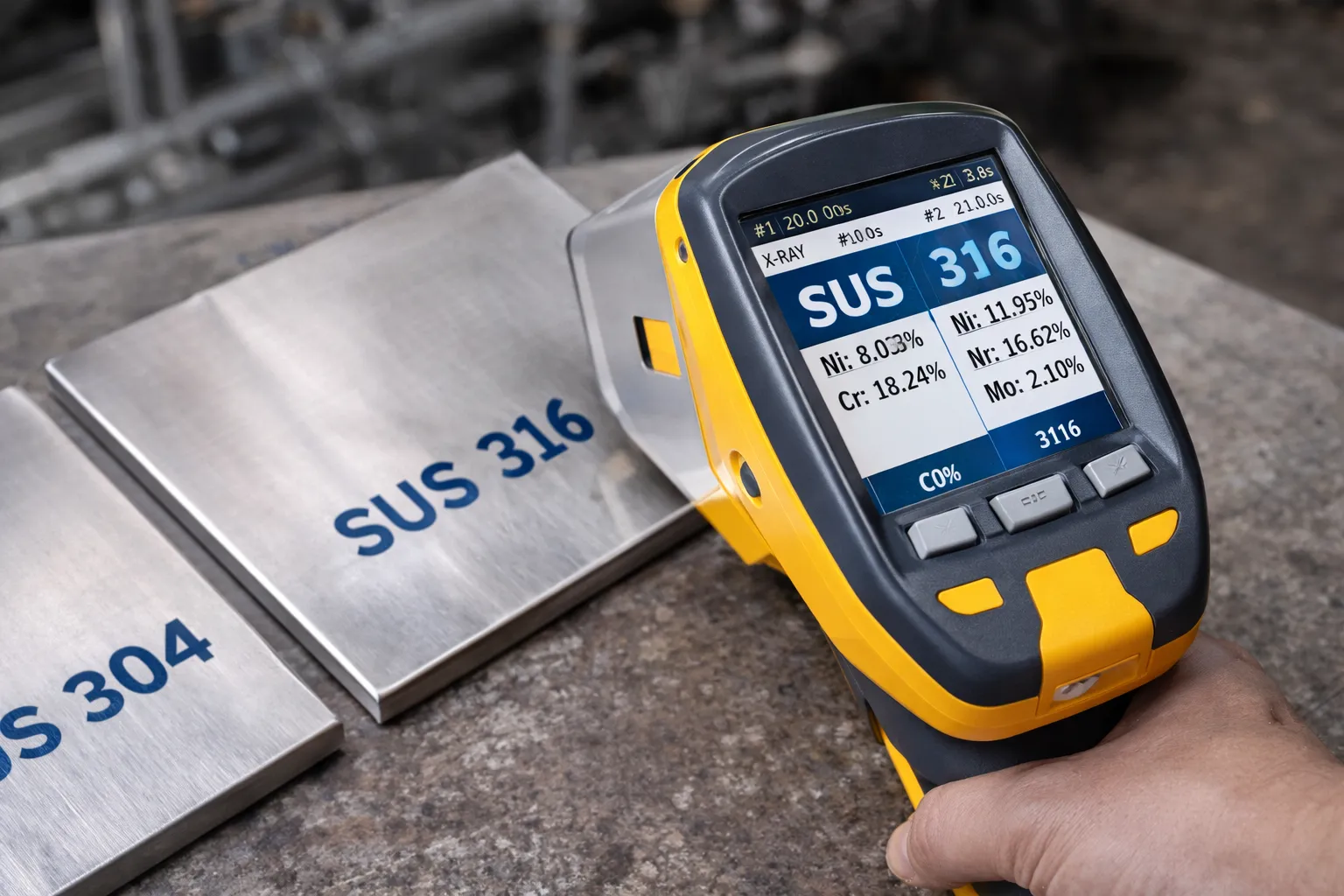
If physical testing is needed, xrf is one of the fastest and most useful options. Portable XRF analyzers can detect the presence of molybdenum, which is one of the clearest signs that the material is 316 rather than 304. This makes xrf one of the most practical field tools for grade confirmation.
For deeper control or disputed material, labs may use optical emission spectroscopy or other advanced methods. These tests are more exact and can confirm trace chemistry in detail. So if the project has strict compliance needs, lab analysis is the safer choice.
Common stainless checking methods
304 from 316 instantly
This is one of the most important points in 304 vs 316 identification. The clearest chemistry difference is that 316 contains molybdenum, while standard 304 does not. That means the presence of molybdenum is one of the strongest indicators that you are looking at 316 or a related grade.
Why does this matter? Because molybdenum makes stainless more resistant in chloride service. It improves pitting resistance and helps the material perform better under exposure to corrosive salts and chemicals. This is why 316 is preferred for marine or washdown use.
So if you want a practical way to tell one from the other, look for the presence of Mo using XRF or another chemical method. That is much more dependable than appearance or magnet behavior.
A spot test can be useful for a quick field check, especially when buyers need a simple yes-or-no clue about molybdenum content. Some kits use chemicals that react differently on 304 and 316. These tests can be convenient, but they require care and interpretation.
A chemical test is better than pure guessing, but it still has limits. Surface contamination, finish condition, and user error can affect results. That is why many professional buyers use spot tests only as screening tools, not as final proof.
If the project value is higher, xrf is usually the better choice. It is fast, non-destructive, and suitable for incoming inspection. For disputes, high-spec industrial work, or export-critical material, lab testing is best. In other words, use a simple method for simple risk, and a stronger method for bigger consequences.
The answer comes back to chemistry and service environment. Both 304 and 316 are corrosion resistant, but not to the same degree. The level of corrosion resistance depends on the alloy and the exposure conditions.
In mild service, both grades may perform very well. But in environments with salt, cleaners, or chloride, the difference becomes clearer. That is why 316 is often chosen for marine, coastal, food, and chemical use. Its superior corrosion resistance comes from the extra molybdenum in the alloy.
This is why the difference between 304 and 316 should always be evaluated against the real job. If the project faces saltwater, coastal air, or repeated chemical cleaning, 316 usually offers safer long-term protection. If the service is dry and mild, 304 may be fully adequate.
Where the difference matters most
| البيئة | 304 performance | 316 performance |
|---|---|---|
| Dry indoor use | Usually good | Also good |
| Mild outdoor use | Often good | Better but may be unnecessary |
| Chloride exposure | Higher risk | Safer choice |
| Marine/coastal use | Can struggle | Usually preferred |
| Chemical washdown | Depends on chemistry | Often stronger |

One common mistake is relying only on a magnet. As noted above, this can help in rough screening, but it is not enough to separate 304 from 316 confidently. Another mistake is assuming price tells the full story. A cheap offer may hide grade substitution.
A second major mistake is skipping documents. Buyers may receive parts marked as “SS” and assume that means the correct grade. But ss is too general. It does not prove whether the material is 304 ss, 316 ss, or another stainless family entirely. Always ask for the specific grade of stainless steel and supporting certificate.
A third mistake is using the wrong field method. Some teams try a spark test, but this is much more useful for separating carbon steel families than for precise austenitic grade identification. In many stainless jobs, the safer path is certificate plus XRF, not workshop guesswork.
Start with the environment. Ask where the part will be used and what it will contact. Is it exposed to indoor moisture, outdoor weather, seawater, cleaners, or a chemical line? That question usually determines whether 304 is enough or if 316 is safer.
Then consider fabrication and budget. Some buyers want the lowest first cost, but total value matters more. If the part will fail early, the lower initial cost is not real savings. A smarter approach is to match the type of stainless to the actual risk level.
For most general indoor and mild-use jobs, 304 may be fine. For coastal or chloride-rich service, 316 is often worth the extra cost. If you need to check stainless steel incoming from a supplier, ask for certificates and use XRF on critical lots. That helps protect quality, consistency, and trust.
As a professional stainless supplier, our advice is simple: do not buy only by label. Buy by chemistry, certificate, and use case. Many failures happen not because stainless is bad, but because the wrong grade was used in the wrong place.
For industrial distributors and wholesalers, consistency matters. For engineering contractors and OEM buyers, traceability matters. For project developers, long-term service life matters. In all these cases, understanding 304 and 316 stainless steel helps you control quality before installation.
If you are still unsure, use a layered process. Start with documents, confirm with XRF, and reserve lab testing for critical material. That approach keeps inspection practical while reducing grade risk in the field.
How can I tell if stainless is 304 or 316?
The most reliable way is to check the material certificate or test the chemistry with xrf. Visual appearance and a magnet alone are not enough for accurate grade identification.
Does 316 stainless steel stick to a magnet?
Usually, not strongly in the annealed condition. But after forming or machining, some magnetic behavior can appear, so magnet response alone is not conclusive.
What is the main difference between 304 and 316?
The main difference is molybdenum. 316 contains it, while 304 generally does not. That improves corrosion performance, especially in chloride exposure.
Can a spot test identify 304 vs 316?
A spot test can help as a quick screening tool, but it is not always enough for final confirmation. For better accuracy, XRF or lab testing is preferred.
Is 304 stainless steel magnetic?
304 stainless steel is generally non-magnetic in the annealed condition, but cold work can create some magnetic pull.
Which is better, 304 or 316?
It depends on the application. 304 is excellent for many general uses. 316 is better where stronger corrosion protection is needed.
The best way to identify stainless steel grade is by certificate or chemical testing.
Visual appearance alone cannot reliably separate 304 and 316.
A magnet can help in rough screening, but not in final grade confirmation.
Xrf is one of the most practical field tools for stainless identification.
The presence of molybdenum is a major sign of 316.
304 and 316 are both austenitic stainless steels, but their corrosion performance differs.
316 is usually safer in chloride and marine conditions.
Buyers should not rely on “SS” markings alone.
The correct grade depends on environment, risk, and service life needs.
A certificate-plus-test approach is the safest way to avoid grade mistakes.
A Manufacturer of Stainless Steel Guardrails
Stainless Steel Square Tube For Power Rack:70*70*3/75*75*3 And Other Specifications
Stainless Steel Square Tube Guide: 304 & 316 Stainless Square Pipe for Structural and Industrial Projects
Stainless Steel Railing Guide: Handrail, Rail, Cable, and 316 Stainless Steel Railing System Components
واتساب