A weak rail may look fine at first, but poor material, loose fittings, or wrong surface finish can create safety risks, corrosion, and costly rework. The better choice is a well-engineered stainless steel railing system built for strength, durability, and clean design.
A stainless steel railing is a durable railing system made from stainless steel posts, handrails, fittings, anchors, cable infill, glass panels, or pipe components. It is used for stairs, decks, balconies, walkways, commercial buildings, and infrastructure projects because it offers corrosion resistance, modern appearance, and long service life.
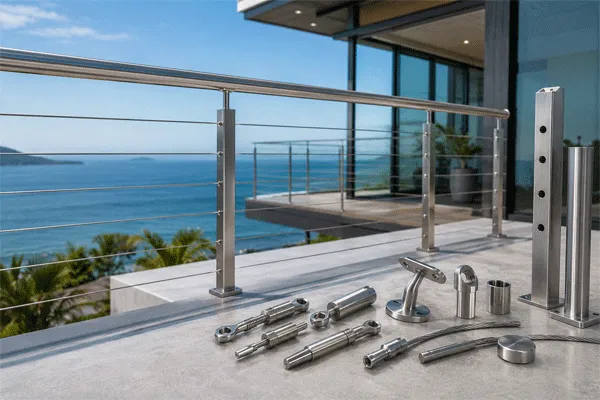
Stainless Steel Railing Guide: Handrail, Rail, Cable, and 316 Stainless Steel Railing System Components
A Geländer aus rostfreiem Stahl is a protective and decorative barrier made from stainless steel parts. It may include a top rail, vertical posts, a handrail, cable, glass, rods, panels, fittings, brackets, terminals, and anchors. It can be used indoors or outdoors for safety, support, and architectural style.
A railing system does two jobs. First, it helps protect people from falls on a stair, balcony, deck, platform, or walkway. Second, it shapes the look of the space. A good rail feels safe, clean, and solid. A poor one feels shaky. Nobody likes a shaky rail. It gives the whole project a bad handshake.
As a professional stainless steel manufacturer and exporter based in China, we often supply railing-related materials for industrial distributors, steel wholesalers, engineering contractors, fabricators, OEM/ODM manufacturers, construction developers, importers, and B2B buying offices. These buyers usually need stable quality, custom size, reliable finish, safe packing, and competitive factory pricing.
Stainless steel is popular because it combines strength, corrosion resistance, and a sleek modern look. It fits both residential and commercial projects. It also works well with many architectural styles, from simple industrial stairways to stylish hotel balconies.
A stainless steel handrail can last for years with proper grade selection and care. Unlike painted carbon steel, it does not rely only on a paint layer for protection. Stainless steel forms a passive oxide layer that helps resist corrosion. When the surface is clean and the grade is correct, the material performs very well in demanding environments.
Main reasons buyers choose it include:
| Vorteil | Warum es wichtig ist |
|---|---|
| Dauerhaftigkeit | Suitable for long-term projects |
| Clean appearance | Good for modern architectural design |
| Korrosionsbeständigkeit | Useful for outdoor and humid areas |
| Stärke | Suitable for stair, deck, and public access use |
| Geringe Wartung | Easy to clean compared with many painted materials |
| Flexible fabrication | Can be cut, welded, bent, brushed, or polished |
For developers and contractors, the real value is not only elegance. It is fewer complaints, easier maintenance, and better project image.
Most stainless steel railing systems are built from several parts. Each component has a job. If one part is weak, the full system suffers.
Common components include:
A cable railing system uses steel cable or stainless cable as the infill. A glass balustrade uses glass panels with posts or clamps. A pipe rail system uses round or square tubes. A square stainless steel post may look sharper and more modern, while a round pipe handrail often feels comfortable to grip.
For OEM/ODM buyers, we can support customized pipe size, wall thickness, length, surface finish, bracket style, connector type, and seaworthy packaging. That matters when you need repeat orders with the same look and size.
The two common choices are 304 stainless steel and 316 stainless steel. 304 is widely used for indoor and normal outdoor environments. 316 offers better resistance in more aggressive places, especially where salt, chemicals, or chloride exposure may appear.
A technical bulletin from the U.S. National Institutes of Health notes that Edelstahl 316 has more nickel and molybdenum than 304, giving it greater resistance to mild chloride solutions and solvents. That is why 316 is often selected for coastal railings, marine-style projects, chemical areas, and high-humidity outdoor work.
Here is a practical comparison:
| Klasse | Am besten für | Buyer Note |
|---|---|---|
| 304 | Indoor stair, residential handrail, general building projects | Cost-effective and widely used |
| 316 | Coastal deck, outdoor rail, marine environment, chemical exposure | Bessere Korrosionsbeständigkeit |
| 2205 | High-strength or severe corrosion projects | Higher cost, special project use |
If your project is near the sea, near a pool, or exposed to deicing salt, 316 is usually the safer choice. If the project is indoor, dry, and budget-sensitive, 304 may be enough. The right grade depends on location, cleaning plan, and expected service life.
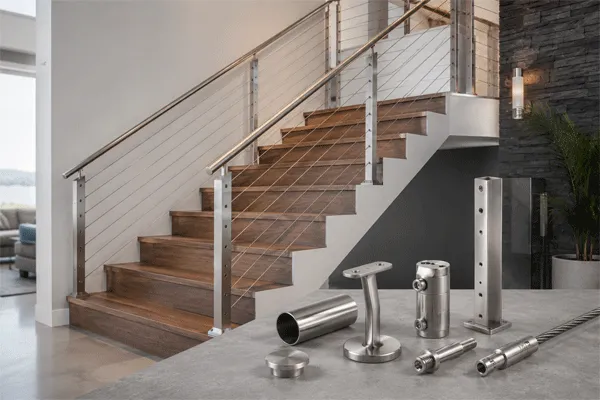
Stainless Steel Railing Guide: Handrail, Rail, Cable, and 316 Stainless Steel Railing System Components
A stainless steel handrail is used in many places: homes, offices, hotels, factories, schools, hospitals, airports, shopping centers, bridges, and public buildings. It works for staircases, platforms, ramps, balconies, terraces, and walkways.
A stainless steel cable railing is popular when the project wants open views. The thin cable lines create a clean visual effect, especially on a deck, balcony, or outdoor viewing platform. It adds safety without making the space feel blocked.
Common applications include:
| Anmeldung | Recommended Railing Style |
|---|---|
| Indoor staircase | Handrail with posts or wall brackets |
| Außenterrasse | 316 cable railing or pipe rail |
| Kommerzielles Treppenhaus | Code-compliant rail and guard system |
| Balkon | Glass or cable infill |
| Industrielle Plattform | Strong pipe rail with durable anchors |
| Öffentliche Infrastruktur | Heavy-duty stainless handrail |
| Residential upgrade | Stylish rail with brushed finish |
For fabricators and contractors, the best system is one that is easy to assemble, strong after installation, and consistent from batch to batch.
There are many railing options. The right choice depends on design, safety rules, budget, and environment.
For a stair, you may use a wall-mounted handrail, post-mounted stair railing, or full guardrail with infill. A stairway must feel secure. It also needs smooth transitions, good grip, and correct height based on local code.
For a deck, buyers often choose cable railing, glass railing, or pipe railing. Outdoor deck projects should consider grade, finish, anchor strength, water drainage, and cleaning. A deck rail gets sun, rain, dust, and people leaning on it. So yes, it needs backbone.
For balconies and architectural projects, glass and stainless combinations are common. They give a bright, open look. For industrial spaces, simple pipe rail is often better because functionality matters more than decorative detail.
The installation quality depends heavily on the fitting system. A beautiful rail with weak fittings is not a real solution. It is decoration with anxiety.
Key parts include:
| Part | Function |
|---|---|
| Handrail bracket | Supports wall-mounted rail |
| Connector | Joins rail sections |
| Terminal | Holds cable ends |
| Anchor | Fixes posts or base plates |
| Adjustable elbow | Helps connect angled rail sections |
| Intermediate post | Supports long rail spans |
| Obere Schiene | Provides grip and structural line |
| Infill | Fills the space between posts |
For contractors, correct installation starts with the drawing. The drawing should show post spacing, rail height, base plate size, anchor holes, stair angle, curve radius, and infill details. If the project has a special curve, custom radius bending may be needed.
For B2B orders, we can supply cut-to-length stainless pipe, stainless steel square tube, brackets, fittings, and custom components based on project drawings. This helps fabricators reduce cutting waste and speed up site work.
Surface finish affects both appearance and maintenance. A brush finish is common for modern projects because it looks clean and hides small marks better than a mirror surface. A polished finish gives a brighter, more decorative look, often used in hotels, showrooms, and premium interiors.
Common finishes include:
For outdoor use, surface quality matters. Rough areas can hold dirt and moisture. Welds should be cleaned properly. In demanding environments, passivation can help improve surface condition. Research on 316L stainless steel shows that passivation can change the surface oxide layer and improve corrosion protection behavior.
When buyers request railing materials, they should confirm grade, finish, thickness, length, tolerance, edge condition, and packaging. Pretty is good. Consistent is better.
A fair estimate depends on material grade, design, size, finish, quantity, fabrication complexity, and packing method. A simple straight rail costs less than a curved staircase system with custom terminals and glass infill.
Cost factors include:
| Cost Factor | Auswirkungen |
|---|---|
| Klasse | 316 costs more than 304 |
| Tube size | Larger pipe or square tube increases material cost |
| Wandstärke | Thicker material raises weight and price |
| Oberfläche | Polishing adds processing cost |
| Cable or glass infill | Changes hardware and labor cost |
| Custom curve | Requires bending and careful control |
| Brackets and fittings | Add hardware cost |
| Verpackung | Export packing protects surface |
| Menge | Bulk orders usually improve unit price |
For importers and steel wholesalers, bulk purchasing can reduce cost when specifications are clear. For engineering contractors, custom-cut lengths can save labor at site. For OEM/ODM manufacturers, stable repeat production helps control both cost and quality.
A good supplier should not only give a price. They should help you understand what that price includes.
Railing and handrail projects must follow local building codes. Requirements may cover height, spacing, load, grip shape, stair dimensions, guardrail design, and accessibility. OSHA states that stair rail systems installed on or after January 17, 2017 must be at least 42 inches high in covered workplace situations, and it also explains when a top rail can serve as a handrail.
Do not use one country’s rule for every project. A residential stair in one market may not follow the same rules as a commercial public building in another. Local engineers should confirm final compliance.
Before production, check:
A railing system is both a product and a safety element. Treat it with respect.
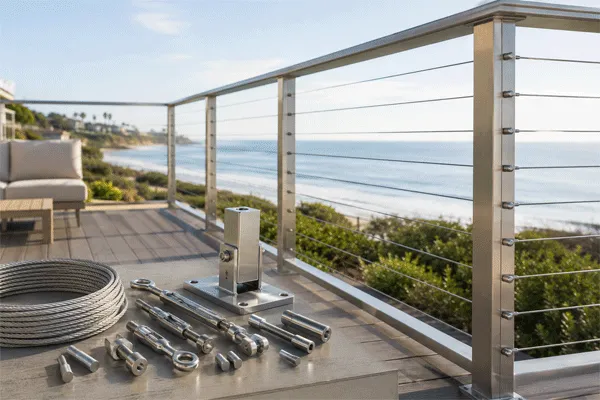
Stainless Steel Railing Guide: Handrail, Rail, Cable, and 316 Stainless Steel Railing System Components
B2B buyers need more than nice photos. They need stable steel quality, reliable processing, export experience, and clear communication. A distributor may need bulk stainless pipe. A fabricator may need custom-cut components. An OEM manufacturer may need a ready-to-assemble kit.
As a professional stainless steel manufacturer and exporter based in China, we support buyers with stainless steel pipes, sheets, coils, square tubes, custom-cut parts, railing fittings, and export packaging. We work with industrial distributors, steel wholesalers, engineering contractors, fabricators, OEM/ODM product manufacturers, construction developers, importers, and B2B buying offices.
Before selecting a supplier, check:
| Supplier Capability | Warum es wichtig ist |
|---|---|
| Grade control | Ensures 304, 316, or 2205 matches requirement |
| Size customization | Supports drawings and project needs |
| Cutting service | Reduces buyer labor |
| Surface finish control | Protects appearance |
| Welding and fabrication support | Helps custom railing projects |
| Inspection documents | Supports quality traceability |
| Export packaging | Prevents scratches and deformation |
| Long-term supply | Supports repeat orders |
Good stainless supply is quiet. It arrives on time, matches the drawing, and does not create drama. That is the dream.
A contractor needed a railing kit for a commercial staircase. The project required stainless posts, a round handrail, wall brackets, base anchors, and cable infill. The local site team could assemble the system, but they wanted pre-cut material to reduce labor.
The solution included:
| Project Need | Stainless Steel Solution |
|---|---|
| Stair handrail | Cut-to-length round pipe |
| Main posts | Brushed 316 stainless pipe |
| Cable infill | Stainless cable and terminals |
| Wall support | Handrail bracket |
| Base fixing | Anchor plate and bolts |
| Assembly | Labeled railing kit |
| Export | Protective packing |
This kind of supply helps contractors work faster. It also helps importers sell a more complete product package instead of only raw material. That is where custom manufacturing creates real value.
304 is suitable for many indoor and general outdoor railing projects. 316 is better for coastal, humid, poolside, or more corrosive environments because it has stronger corrosion resistance.
Yes, stainless steel railing can be excellent for outdoor use when the correct grade and finish are selected. For harsh outdoor or marine environments, 316 is usually preferred over 304.
A rail is a general support or barrier element. A handrail is specifically designed for people to hold while walking on stairs, ramps, or platforms. A top rail may sometimes also function as a handrail if the design meets local code.
Cable railing can be safe when it is properly engineered, tensioned, anchored, and installed according to local building rules. Cable spacing, post strength, terminal quality, and top rail design all matter.
Yes. Stainless railings can be customized by grade, pipe size, wall thickness, finish, length, bracket style, connector type, cable system, glass infill, and packaging. OEM/ODM customization is common for B2B buyers.
Yes, but maintenance is usually simple. Clean the surface regularly, remove salt or dirt, avoid harsh chemicals, inspect fasteners, and repair scratches or damaged areas early.