A beautiful cable railing can quickly become a problem if the space between each cable is too wide. That can create failed inspections, extra rework, and a real safety risk. The solution is simple: design the system around code, tension, and proper post layout from the start.
For most projects, the practical answer is that перила з нержавіючої сталі and cable openings must be tight enough that a 4-inch sphere rule test is met that a 4-inch sphere rule test is met, because guards generally cannot allow a 4-inch sphere to pass through. Since cable can flex, many manufacturers recommend spacing horizontal cable runs about 3 inches apart and using closer post support to control sag and cable deflection. Always confirm with the IRC, IBC, and your local building authority before installing.
What does the cable railing spacing code actually require?
Why does the 4-inch sphere rule matter so much?
What is the best cable spacing for a cable railing system?
How does post spacing affect tension and code performance?
What are the height requirements for a guardrail, balcony, and deck railing?
What are the handrail requirements for stairs?
How do load rules like 50 lbs and 200 lbs affect railing design?
Why do intermediate posts matter in cable railing systems?
What materials and fittings work best for stainless steel cable railing?
How can buyers choose a compliant supplier for residential and commercial projects?
If you are buying railing materials for a deck, balcony, stair, or large project, this guide is worth reading because spacing is not just a design detail. It affects inspection, safety, labor, material cost, and long-term customer trust. As a professional stainless steel manufacturer and exporter based in China, we often help distributors, fabricators, contractors, and OEM buyers solve one common issue: how to build a clean-looking system that won’t obstruct your view while still staying compliant.
The key rule behind most cable railing spacing code questions is the opening limitation for guards. Under the IBC, required guards generally cannot have openings that allow a 4-inch sphere to pass through. The IRC also uses the same basic 4-inch opening rule for guards in typical residential applications, including many deck and balcony conditions.
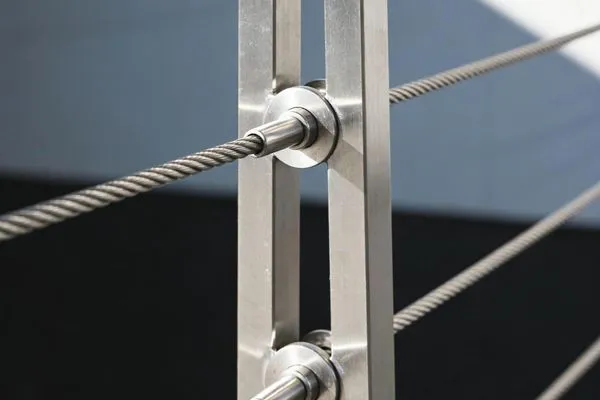
That sounds simple, but there is one catch: cable is flexible. Unlike rigid glass or pickets, a cable can move when force is applied. That means you cannot just measure the empty space between relaxed cable strands and assume the system passes. The full design of системи кабельних перил has to consider tension, post spacing requirements, end fitting strength, and the amount of movement between supports. Feeney, a major cable railing manufacturer, explains that the 4-inch rule still applies and recommends tighter cable layout to account for flex.
So the practical answer is this: the code governs the maximum opening, and the installer or designer must choose a cable railing system layout that still passes the opening test after the force applied causes the cable to move.
The 4-inch sphere rule exists because openings in a guardrail are limited for safety. The intent is to reduce the chance that small children can pass through or become trapped in an opening. Under the IBC, most required guards cannot allow a 4-inch sphere to pass from the walking surface up to the required guard height.
For cable railing, that makes the design more sensitive than many people expect. A layout that looks tight on paper can fail the sphere test if the cable run is too long, if the posts are too far apart, or if there is not enough amount of tension in the line. In real projects, this is one of the most common reasons a railing that looked fine in the shop does not satisfy the inspector on site.
That is why smart buyers do not treat the code as a simple gap chart. They treat it as a performance rule.
In practice, many suppliers and fabricators use about 3 inches of vertical cable spacing between runs for horizontal systems. The reason is not that the code literally says “3 inches.” The reason is that this tighter spacing helps the railing still pass the 4-inch opening rule after some cable deflection occurs. Feeney specifically recommends spacing the cables no more than 3 inches apart to help meet the intent of the code.
So if someone asks, “What is the space for a stainless steel wire balustrade?” the honest answer is: the final opening must not let a 4-inch sphere through, but a common field approach is to use about 3-inch cable spacing with proper tension and support. This is especially common in residential and light commercial railing systems where a clean view matters.
A simple planning table helps:
| Design Item | Common Practical Approach | Чому це важливо |
|---|---|---|
| Vertical space between horizontal cable runs | About 3 inches | Helps prevent 4-inch sphere failure after flex |
| Maximum post spacing | Often around 3 to 4 feet, depending on frame strength | Reduces sag and mid-span opening |
| Cable type | 1×19 strand stainless cable | Lower stretch, cleaner appearance |
| End hardware | Strong end пристосування and tensioning hardware | Maintains long-term tension |
The right answer still depends on project details, but this is a proven starting point.
Post spacing is one of the biggest factors in a good cable railing installation. The wider the distance between posts, the more each cable run can move when pressure is applied. That extra movement can create a bigger opening and make it easier for a sphere to pass through the infill area. This is why manufacturers often recommend a post or vertical support every 3 feet or so, even though the exact layout depends on the frame and design.
In other words, the real issue is not just cable-to-cable spacing. It is the relationship between cable spacing, post stiffness, and tension. If the system uses strong structural posts, proper end anchor design, and well-placed intermediate posts, it will hold shape better and be easier to keep compliant over time.
For many projects, buyers should ask these questions early:
What are the exact post spacing requirements?
Do we need an intermediate support between end posts?
What is the recommended post every 3 feet or 4 feet layout for this frame?
How much tension does each line need after installation?
Those details matter more than product photos.
The height requirements for guards depend on the code and occupancy type. Under the IBC, required guards are generally at least 42 inches high. For many one- and two-family residential decks under the IRC, common practice is a minimum 36-inch guard height, though some state and local rules are stricter. Decks.com notes that some jurisdictions, including California, require 42 inches even in residential settings.
That is why a deck railing on a private home and a balcony guard on a commercial building should not be treated the same. IBC projects often need 42-inch guards, while IRC projects may allow 36 inches, depending on the jurisdiction and local code adoption.
Here is a quick summary:
| Project Type | Typical Guard Height |
|---|---|
| Житловий deck under IRC | Often 36 inches |
| Commercial / multifamily under IBC | 42 дюйма |
| Some state and local codes | May require more |
Always verify the current adopted code with the local building department before ordering materials.

Системи стійок та поручнів
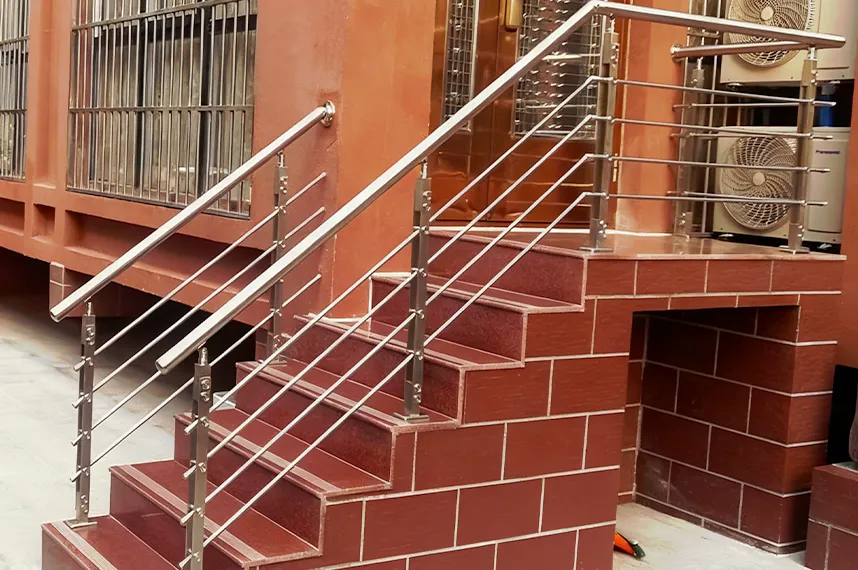
A stair guard and a поручень з нержавіючої сталі для сходів are related, but they are not always the same thing On a stair, the handrail requirements focus on graspability, height, and safe use, while guard requirements focus on fall protection and opening limits. For many stair applications, common handrail heights are 34 to 38 inches, measured above the stair nosing line. That range is also reflected in code summaries widely used by the industry.
This matters because a stair project may involve both a handrail and a cable infill guard. The buyer must confirm whether the top rail is serving as the handrail, whether a separate handrail is needed, and how the infill performs near the stair slope and lower triangle opening. On stairs, the code can allow different opening dimensions in specific zones, but the design still needs full code compliance.
When fabricators specify a stair system, they should check not only cable layout, but also grip profile, mounting height, and transitions at landings.
Openings are only part of the story. Railings and guards must also meet structural load requirements. ICC/ASCE references reflected in code materials require handrails and guards to resist a linear load of 50 lbs per linear foot and a concentrated load of 200 lbs applied in any direction. The infill area of guards also has its own loading consideration.
These loads matter because a cable railing system is not just decorative infill. The frame, end posts, terminals, and top rail all need to work together as a load-bearing assembly. If the posts are too weak, the aluminum or stainless steel frame is undersized, or the top rail is not properly connected, the cables may lose tension or the whole guard may fail under test.
This is also why engineers, fabricators, and contractors should not look at cable diameter alone. A well-performing railing depends on the full structural path.
Many buyers want the most open view possible, so they try to reduce the number of posts. Visually, that sounds good. Structurally, it can create problems. Intermediate posts or vertical supports reduce the unsupported length of each cable run, help control sag, and make it easier for the system to stay tight enough that the opening still meets the code after the cables are loaded.
In many cases, an intermediate support is more cost-effective than trying to over-tighten the cables. Too much force can overload the end structure, damage fittings, or distort posts. Good design balances amount of tension, support spacing, and frame strength. That is why experienced suppliers talk about the entire railing assembly, not just the cable itself.
A good rule in planning is to discuss post locations before final fabrication drawings are approved.
For most architectural railing jobs, stainless steel cable is the preferred choice because it offers strength and good resistance to corrosion, but buyers should still understand which steel is best for railing before choosing 304, 316, or duplex grades.
The posts can be stainless, steel, wood, or aluminum posts, depending on the project. If the system uses aluminum, buyers should pay close attention to the frame engineering, because post stiffness is critical for controlling cable movement. The same is true when combining a stainless cable infill with mixed-material rails or decorative frames.
Hardware selection matters too. End terminals, washers, concealed receivers, and tensioning tools such as a swager all affect how easy the system is to assemble and maintain. In real life, cable railings may need to re-tension after initial settling, especially if the frame moves slightly after use or weather exposure.
For B2B buyers, the best supplier does more than sell cable and hardware. It should also provide custom railing solutions based on project code, post layout, material grade, and installation needs.The right partner helps you specify the full cable railing system, including post layout, fittings, recommended post spacing, top rail details, and installation support. That is especially important for industrial distributors, engineering contractors, and OEM/ODM manufacturers sourcing for large projects.
We usually suggest asking suppliers for six things:
Recommended cable spacing and post spacing
Frame specification for end posts and structural posts
Recommended fitting type for each frame material
Suggested tension process and swager tools
Evidence the design is intended for code requirements
Installation guidance for the adopted jurisdiction
That approach is useful whether you are installing a simple home deck, a stair renovation, or a larger balcony and public-works project.
Imagine a contractor building a premium residential deck with horizontal cable infill. If the design uses wide post spans and larger gaps between each cable, the system may look fine on day one but fail the 4-inch opening test when force is applied. That means extra labor, more call-backs, and sometimes a complete rework.
Now imagine the same project designed with about 3-inch space between each cable, strong end posts, and a support post every few feet where needed. The material cost may be slightly higher, but the project is more likely to pass inspection the first time and stay tight after service. In B2B terms, that is a better margin decision.
Сходові балясини
What is the standard spacing for cable railing?
There is no single code sentence that says “all cables must be X inches apart.” The code focuses on the opening limit, usually the 4-inch sphere rule. In practice, many manufacturers recommend about 3 inches between horizontal cable runs to account for flex.
What is the maximum post spacing for cable railing?
It depends on the frame design, but many manufacturers recommend support at about 3 feet to help control cable deflection and opening size. Some systems can go wider with stronger engineering, but that should be verified by design and code review.
What code applies to a residential deck railing?
For many one- and two-family homes, the IRC applies. For commercial, multifamily, and many public projects, the IBC applies. Your local code adoption always controls.
Do cable railings pass code?
Yes, cable railings can pass code, but only when the full system is designed so the required opening limit is maintained under load and movement. The system must also satisfy guard height and structural load rules.
What height should a cable guardrail be?
Many residential deck guards are commonly 36 inches under IRC-based practice, while IBC guards are generally 42 inches high. Some jurisdictions require more.
Is stainless steel good for outdoor cable railing?
Yes. Stainless steel is widely used for cable railing because of its strength and resistance to corrosion, especially when paired with suitable hardware and proper maintenance.
The real rule is usually the 4-inch sphere opening limit, not a single fixed cable-gap number.
In practice, about 3 inches between horizontal cable runs is a common way to help satisfy the code intent.
Post spacing matters as much as cable spacing because it affects movement and opening size.
IBC projects usually require 42-inch guards; many IRC residential decks use 36 inches.
Stairs may also need separate handrail checks, including handrail heights.
Guards and handrails also need to resist structural loads such as 50 lbs per linear foot and 200 lbs concentrated load.
A good cable railing design balances view, safety, tension, fittings, and local inspection requirements.
What Is the Spacing for Stainless Steel Wire Balustrade? Cable Railing Spacing Code, Deck Rules, and Post Layout Explained
How Jiuguang Metal Presented Precision Stainless Steel Tube Solutions at the Shanghai International Fitness Expo
Jiuguang Metal Showcased Precision Stainless Steel Tubes and Structural Fabrication Capabilities at the Shanghai International Fitness Expo
Can 316 Stainless Steel Be Welded? Best Practices for Welding 316 Stainless, 316L, and 316L Stainless Steel