Wrong material choice can make a beautiful railing stain, pit, or fail too soon. That means callbacks, unhappy buyers, and higher maintenance costs. The smart fix is simple: choose the right stainless steel grade for the location, finish, and exposure level before production starts.
For most indoor and many standard outdoor projects, 304 stainless steel is a practical choice. For coastal zones, pool decks, marine applications, and other harsh environments, 316 stainless steel is usually the better option because its molybdenum addition improves resistance to chlorides and corrosion. In more demanding projects, 2205 duplex stainless steel may be worth considering for higher strength and stronger corrosion performance.

Why is stainless steel such a popular choice for railing projects?
What makes a stainless steel railing system different from other materials?
Is 304 stainless steel good enough for indoor and standard exterior use?
Why is 316 stainless steel often the better choice for outdoor railings?
What role do corrosion and chloride exposure play in grade selection?
Should you consider 2205 or duplex stainless steel for tougher jobs?
How do finish, cleaning, and fabrication affect rust and long-term appearance?
What about railing fittings, weld quality, and installation details?
How do I choose the right grade of stainless steel for residential and commercial projects?
Which stainless steel is best for your railing system?
A modern railing needs more than a good look. It needs safety, weather performance, and stable long-term value. That is why stainless steel is one of the most widely specified materials for a handrail, balustrade, and architectural guard system. It combines a clean finish with strong mechanical performance and a long service life when the correct grade is used.
From my experience as a professional stainless steel manufacturer and exporter based in China, buyers usually want three things at the same time: a modern look, reliable supply, and fewer future complaints. A good перила из нержавеющей стали project can deliver all three. That is especially true for industrial distributors, contractors, OEM manufacturers, and importers sourcing for residential and commercial jobs.
A railing system made from stainless steel is different because the material contains enough chromium to form a passive surface film that helps resist staining and corrosion. In common austenitic grades, chromium and nickel are the core alloying elements, and in 316 stainless steel, molybdenum is added to improve performance in chloride-bearing conditions.
That passive film is why stainless is widely chosen for visible architecture. But it is important to remember something many buyers miss: stainless steel doesn’t mean stain-proof in every situation. Poor finish selection, trapped dirt, iron contamination, and inadequate cleaning can still lead to surface rust or tea staining, especially in coastal or polluted air.
Да, 304 нержавеющая сталь is often a solid and cost-effective choice for many indoor and moderate outdoor applications. It is an austenitic alloy with good formability and weldability, which makes it common for architectural tubing, posts, and fitting components. In many standard city and indoor projects, grade 304 performs well and gives a clean, bright finish.
For that reason, 304 may be the right answer when the job is suitable for indoor use or sheltered exterior spaces with limited chloride exposure. It is often a popular choice for residential stairs, interior balconies, office handrail systems, and dry commercial buildings. It also helps control cost when compared with more expensive grades.
Still, I would not recommend treating 304 stainless steel as the universal answer. Where there is salt, pool chemistry, or constant dampness, its long-term appearance risk increases. That is where grade 316 becomes the smarter option.
If the project is near sea air, salt splash, de-icing salts, or chemically aggressive cleaning conditions, 316 stainless steel is often the better answer. The key difference is its molybdenum content, which improves resistance to chlorides and localized corrosion compared with 304. That is why many engineers treat marine-grade stainless as the safer choice for exposed exteriors.
For railings near the coast, pool decks, and many marine applications, 316 is usually the safer long-term material. Industry guidance commonly points to grade 316 or 316L as the preferred stainless choice in coastal environments, especially when good finish selection and regular cleaning are also part of the plan.
So if a buyer asks me which stainless steel is best for a balcony on the coast, my practical answer is clear: use 316 stainless steel, not grade 304, unless you are fully comfortable with a shorter aesthetic life and more maintenance risk. That is why 316 stainless steel is widely seen as the safer choice for railing in harsher exterior conditions.
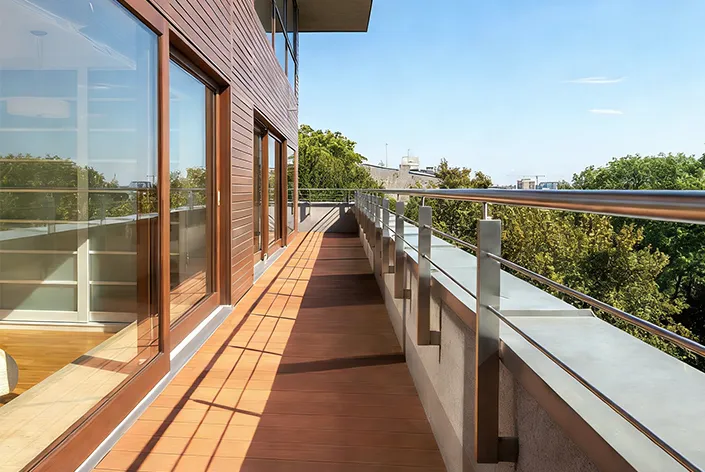
Residential Balcony Handrails
This is the real decision point. Corrosion risk is not just about rain. It is about salts, crevices, deposits, cleaning chemicals, and how long the surface stays damp. In railing work, chloride exposure is often the biggest hidden issue because chlorides increase the risk of pitting, staining, and crevice corrosion.
That is why corrosion resistance should be tied to location, not only to budget. A dry indoor stairwell is one thing. A seaside hotel balcony is another. A public cable railing around a pool deck is another again. When the environment gets harder, the grade should move up as well.
Quick guide by environment
| Окружающая среда | Suggested grade | Примечания |
|---|---|---|
| Indoor dry spaces | 304 | Good value, clean finish |
| Standard urban exterior | 304 или 316 | Depends on wash-down and pollution |
| Coastal zones | 316 | Better chloride performance |
| Pool decks | 316 | Better for splash and chemical exposure |
| Severe chloride or industrial exposure | 2205 | Consider for tougher jobs |
The table above is a practical sourcing guide, not a substitute for engineering review. But for most buyers, it is the right place to start.
Sometimes yes. 2205 is a duplex stainless steel grade with higher strength than common austenitic grades and very good corrosion performance. Outokumpu describes 2205 as offering very good resistance to uniform and localized corrosion and stress corrosion cracking, while also providing high mechanical strength.
For a railing project, that means 2205 can be attractive in very demanding environments, or where slimmer sections and higher strength are desired. It is not always the first commercial choice because it can be more specialized and may affect fabrication cost and supply decisions. But for certain infrastructure, waterfront, and high-exposure projects, it is worth serious consideration.
In other words, if 316 is the mainstream exterior solution, 2205 is the upgrade path when corrosion risk and structural demands both rise.
A common misunderstanding is that if the right grade is selected, maintenance no longer matters. That is not true. Finish quality, fabrication cleanliness, and wash-down routines all affect how a stainless railing looks over time. In exposed areas, deposits from salt and pollution can trigger tea staining or cosmetic discoloration, even when the underlying stainless remains structurally sound.
The British Stainless Steel Association notes that routine cleaning schedules should be adjusted by environment, including rural, urban, and coastal sites. It also notes that some visible rust marks can come from contamination by ordinary steel particles rather than failure of the stainless itself. That is important on construction sites where cutting dust and ferrous contamination are common.
To help prevent rust and staining
choose a suitable finish for the site
avoid carbon steel contamination during fabrication
remove site dirt and chloride deposits
use proper cleaners
schedule regular cleaning for exposed exteriors
This is one reason a railing manufacturer should think about more than just tube grade. The finish and maintenance plan matter too.
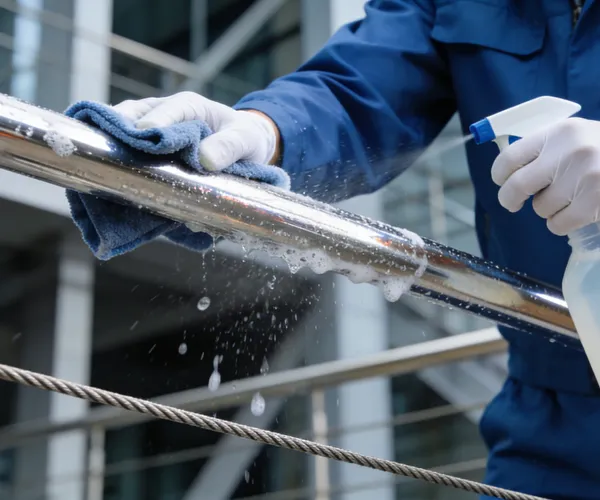
Как чистить тросовые перила из нержавеющей стали
A railing is not only tube. The posts, brackets, glass clamps, anchors, and railing fittings matter just as much. If the tube is 316 but the fasteners or connectors are lower-grade used stainless, the system can still become the weak point. Matching the fitting grade to the main material is a basic but important rule.
Good fabrication also means controlling heat tint, avoiding contamination, and using correct filler where needed to weld the system properly. Austenitic grades such as 304 and 316 generally offer good formability and are widely fabricated, but poor welding and poor post-fabrication cleaning can reduce appearance and corrosion performance.
For that reason, I usually suggest buyers review the full railing system, not only the visible tube. Ask about:
tube grade
connector grade
обработка поверхности
weld cleanup
installation environment
cleaning plan
That is how you protect long-term value, especially for bulk projects.
To choose the right material, start with the site, not the catalog. Ask where the railing will be used, how close it is to saltwater, whether it will see pool chemicals or harsh chemicals, how often it will be cleaned, and how visible it is to the public. Those answers usually guide the grade of stainless steel faster than price discussions do.
Here is the practical buying logic I use with B2B customers:
Use 304 for indoor or lower-risk exterior work.
Use 316 for exterior railings, balconies, coast-adjacent projects, and pool areas.
Consider 2205 for severe exposure or higher-performance engineering demands.
This approach works well for distributors, contractors, OEM manufacturers, and importers because it balances supply, performance, and budget.
For many mainstream projects, 304 is enough. For many exposed exterior jobs, нержавеющая сталь 316 is the best balance of durability, corrosion performance, and availability. For severe chloride service, 2205 can be a strong upgrade path. So the answer is not one grade for everything. It is the right grade for the right site.
If you want the simplest rule:
indoor and sheltered: 304
outdoor and coastal-adjacent: 316
severe corrosion and high strength needs: 2205
That is the most practical guide for choosing the best stainless solution for a railing system.
Is 304 or 316 better for a handrail?
For indoor or sheltered use, 304 is often fine. For coastal, poolside, or more corrosive environments, 316 is usually better because its molybdenum content improves chloride resistance.
Can stainless steel railing rust?
Yes, it can show staining or localized corrosion in the wrong environment, or if contaminated or poorly maintained. “Stainless” means corrosion-resistant, not immune to every condition.
Why is 316 called marine-grade?
Because 316 performs better than 304 in chloride-rich conditions, including many coastal and marine-adjacent applications.
Is 2205 better than 316 for railings?
In some harsh environments, yes. 2205 duplex stainless offers higher strength and very good corrosion resistance, but it is not always necessary for standard architectural work.
What causes tea staining on stainless railings?
Tea staining is a cosmetic brown discoloration linked to corrosive deposits such as salt and pollution, especially in coastal or exposed sites. It mainly affects appearance and is influenced by finish, cleaning, and environment.
Do railing fittings need to match the tube grade?
Yes, as a rule they should. Mixed-grade components can weaken the overall corrosion performance of the installation.
Stainless steel is a strong, clean-looking option for a railing project when the correct grade is chosen.
304 is commonly suitable for indoor and moderate environments.
316 stainless steel is usually the better choice for coastal zones, pool decks, and other chloride-exposed sites.
2205 duplex stainless steel is worth considering for harsher exposure or higher strength demands.
Finish, fabrication, and cleaning all affect long-term appearance and staining risk.
The full система перил matters, including fittings, welds, and installation details.
The best grade is the one that matches the real environment, not just the lowest upfront price.