If you choose the wrong thickness, you don’t just “waste steel.” You risk leaks, rework, failed inspections, or a pipe that can’t handle pressure. That’s expensive—and stressful. In this guide, I’ll show a simple, engineer-friendly way to calculate and determine the minimum required wall thickness and then select a real-world size you can buy and fabricate.
To calculate tube thickness, you (1) confirm whether you’re sizing tube or pipe, (2) gather the key inputs—design pressure, outside diameter, temperature, and allowable stress, (3) use an ASME-style formula to get the minimum thickness, then (4) add corrosion and manufacturing allowances and pick a standard size (schedule or gauge). ASME-based approaches commonly use equations like the ASME B31.3 wall-thickness relationship.
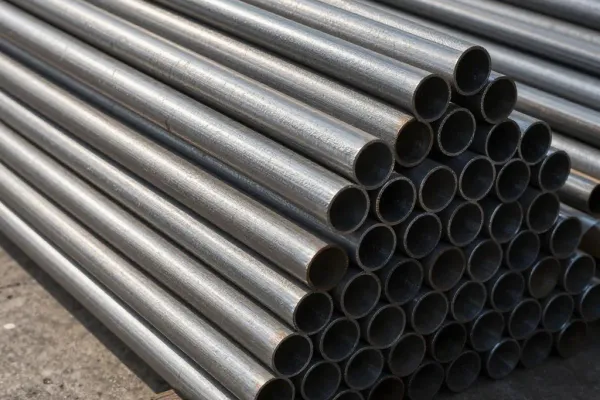
tubo
Como um Fabricante e exportador profissional de aço inoxidável com sede na China, we support industrial distributors, contractors, OEM/ODM factories, and buying offices with bulk supply, consistent material quality, and custom cutting—so your design values match what you receive on site.
Tube or pipe: what are you calculating, and why does it change the reference?
What inputs do you need to calculate wall thickness?
ASME B31.3 formula: how to calculate the minimum required wall thickness for internal pressure?
ASME Section VIII reference: when does a “cylinder” approach apply?
How to measure thickness in the real world (OD, ID, and weld area)?
Tube calculator workflow: a simple step-by-step calculation example
How do material properties and temperature affect required thickness?
Design extras: corrosion, tolerance, weld factors, and safety margins
Pipe wall thickness and schedules: how to select a standard size fast
People often say “tube” and “pipe” like they are the same. In buying and engineering, they are not always the same. A tube is commonly ordered by exact outside diameter and wall thickness. A pipe is commonly ordered by nominal size (NPS) plus a schedule that implies a pipe wall thickness.
Why this matters: your calculation uses diameter (often OD) and a thickness assumption. If you mix up tube vs pipe, you may end up selecting the wrong stock size—even if your math is “correct.”
Quick rule (simple):
If you buy by exact OD + WT → treat it as tubulação.
If you buy by NPS + schedule → treat it as pipe.
Before you touch any calculator, gather a clean set of inputs. These inputs become your variable list.
| Input | What it means | Por que é importante |
|---|---|---|
| design pressure | The pressure you must withstand | Drives stress and required thickness |
| diâmetro externo (OD) | Measured outside of the tube/pipe | Used in many ASME pipe equations |
| material grau | e.g., 304/316 stainless or another alloy | Changes strength and corrosion behavior |
| temperature | Operating/design temperature | Affects allowable stress |
| Joint / weld factor | How efficient the solda is (if applicable) | Reduces allowed strength in the equation |
| Corrosion allowance | Extra thickness for expected corrosion | Added after base calculation |
When we quote stainless projects for contractors and OEM factories, we also ask about: internal media, cleaning chemicals, and inspection requirements. Those details influence design decisions, not just math.
For process piping, engineers often reference ASME B31.3 style relationships. A commonly cited ASME B31.3 equation form is:
t = P · D / (2 (S · E + P · Y))
Where t is the required thickness, P is internal pressure, D is outside diameter, S is allowable stress, E is joint quality factor, and Y is a code factor.
This is not a “one-size-fits-all” promise. It’s a reference method used under specific assumptions and code scope. Still, it’s a very practical starting point for sizing pipe and tube under internal pressure.
Plain-English meaning:
Higher pressure → higher needed thickness.
Bigger diameter → higher needed thickness.
Higher allowable stress (stronger steel) → lower needed thickness.
Lower weld quality factor → higher needed thickness.
If you are sizing a pressure vessel shell or a cylindrical component treated like a cylinder, engineers often look at ASME Section VIII concepts (different scope than piping). A well-known thin-shell style relationship in that world is commonly shown in UG-27 discussion forms like:
t = P · R / (S · E − 0.6P) (for certain thin-shell assumptions)
You’ll see this style referenced in engineering explanations of ASME Section VIII Div 1 internal pressure design of cylinders.
Practical takeaway for buyers and fabricators:
Don’t mix code scopes casually. If your project is piping, stay in piping rules. If it’s a vessel, treat it as a vessel. If you’re not sure, ask your design engineer or code consultant early. That single decision prevents expensive redesign later.

tube Thickness
In the workshop, thickness is not only “a number on paper.” You need a reliable measurement method.
Measure the outside diameter (OD).
Measure the id (inside diameter) if accessible.
Then subtract the inside diameter from OD and divide by two:
Wall thickness = (OD − ID) / 2
This simple equation helps confirm incoming material when you receive tubing. It’s not a replacement for code calculation, but it’s a practical QA tool.
If it’s welded tube, the weld seam area may behave differently depending on process and spec. That’s why many buyers ask for inspection documents and consistent manufacturing control. As a supplier, we typically support requests for MTCs and traceable production batches (depending on order terms).
Let’s do a clear example you can copy into your own tube calculator sheet.
Goal: calculate the minimum thickness for a stainless line under internal pressure.
design pressure = (your value)
outside diameter = (your OD)
material = stainless steel grade (your choice)
temperature = operating/design
choose an allowable stress from the code/material table
choose E and Y per the relevant standard
The value choices for allowable stress and code factors must come from the correct asme code documents.
Use the ASME B31.3 style formula:
required thickness = P·D / (2(S·E + P·Y))
After you calculate the minimum, you typically add:
corrosion allowance (corrosion)
manufacturing tolerance / mill negative tolerance
any extra margin required by the project spec
This gives you the minimum required thickness you should order, not just a theoretical number.
Your material properties matter because different stainless and alloy choices have different allowable stresses and corrosion behavior.
Higher-strength steel can allow a thinner wall for the same pressure case.
Higher temperature can reduce allowable stress, so required thickness can increase.
Corrosive media may demand extra thickness or a different alloy entirely.
This is why distributors and buying offices often ask us for “best-value alternatives.” We can propose options, but your final selection should be tied to the project design and service conditions.
“Good thickness design is not just math—it’s matching pressure, temperature, and corrosion to a real supply size you can weld and inspect.”
In many real projects, the computed thickness is not the thickness you buy.
corrosion allowance (even small)
weld factors (especially for longitudinal welds or specific processes)
inspection method limits (UT coverage, acceptance criteria)
fabrication processes (bending, expanding, machining)
Buyer tip: if you are an importer or wholesaler stocking sizes, align inventory with what fabricators actually use: popular OD ranges, common schedules, and cut-to-length services.
As a China-based exporter, we often support:
bulk coil/plate + slitting for tube mills
cut-to-length and end prep
packing designed for container shipping (reduce damage risk)
Many projects don’t want a custom thickness. They want a standard schedule that is available worldwide.
A schedule chart lets you map nominal size to an OD and a wall thickness range (depending on standard). You’ll find schedule and thickness tables for common standards such as ASME/ANSI B36.10/B36.19 referenced in thickness PDFs and pipe brochures.
Practical selection method (fast)
Do the code calculation to find the minimum thickness.
Compare it to standard schedule options for that NPS.
Select the next standard wall above your minimum + allowances.
Confirm availability with your supplier (lead time, MOQ, tolerances).
This approach is “minimal” but effective—especially for distributors and contractors who need a precise and fast answer.
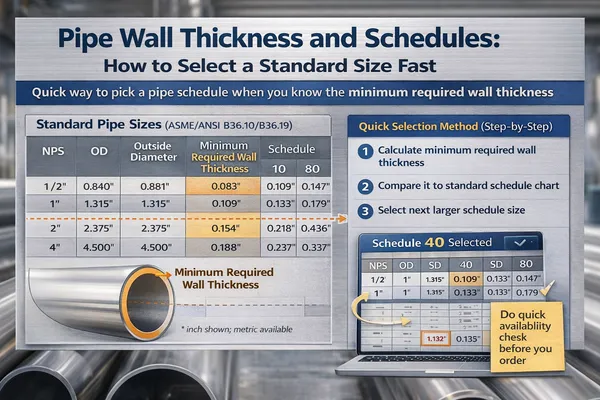
Pipe wall thickness and schedules
How do I calculate tube thickness from OD and ID?
Use wall thickness = (OD − ID) / 2. This is a geometry check based on measure the outside diameter and inside diameter. It helps verify incoming tubing but does not replace ASME design calculations.
Is tube thickness the same as pipe wall thickness?
Not always. Tube is commonly specified by exact OD and wall thickness. Pipe is commonly specified by NPS and schedule, which implies a wall thickness.
Can I use an online calculator for ASME thickness?
A calculator can help you run the math quickly, but you must use correct inputs from the asme documents (allowable stress, factors, scope). Treat calculators as a tool, not an authority.
What is the minimum required wall thickness in ASME B31.3 style sizing?
It’s the computed thickness needed to safely withstand internal pressure given OD, allowable stress, and code factors—before you add corrosion and tolerance allowances. A common equation form is shown in ASME B31.3 references.
Why does temperature change the required thickness?
Because allowable stress typically changes with temperature. Higher temperature can reduce allowable stress, which pushes required thickness up for the same pressure case.
How do contractors select thickness for exchangers and process equipment tubing?
For an exchanger or pressure-containing equipment, engineers choose the governing code scope (piping vs vessel), then calculate minimum thickness and select a practical tube/tubing size that meets fabrication and inspection needs. (Always confirm with project specifications and code requirements.)
Thickness design starts with the right category: tube vs pipe.
To calculate code thickness, you need pressure, OD, temperature, and allowable stress (material properties).
ASME B31.3-style equations are widely used as a reference for piping thickness sizing. After you get the minimum, add corrosion and tolerance to reach the real order thickness.
Pick a standard schedule/wall that’s available in the market and fits your weld and inspection plan.
A calculator speeds up math, but correct inputs and code scope decisions make it “right.”
If you share your OD/NPS, design pressure, temperature, and target stainless grade, I can help you set up a clean “tube calculator” worksheet format (inputs → thickness result → standard size selection) that your sales and engineering teams can reuse for RFQs.
Stainless Steel Stair and Handrail Systems Supplied for an Indoor and Outdoor Precinct Project in Australia
Stainless Steel Staircases and Handrail Systems Delivered for an Indoor and Outdoor Precinct Project in Australia
Which Type of Stainless Steel Is Good for Railings? Choosing the Best Stainless Steel Railing System for Long-Term Performance
How to Identify Stainless Steel and Mild Steel: Key Differences Between Stainless Steel and Mild Steel