You receive stainless steel materials, but the grade isn’t clearly labeled.
Using the wrong grade can lead to unexpected corrosion, failed inspections, or costly rework.
In this guide, I’ll show you practical, proven ways to identify stainless steel—specifically 304 vs 316—based on real factory and export experience.
You can tell whether stainless steel is 304 or 316 by combining visual checks, magnet behavior, chemical spot tests, and elemental analysis. The key difference is the presence of molybdenum in 316 stainless steel, which gives it higher corrosion resistance—especially in chloride environments.
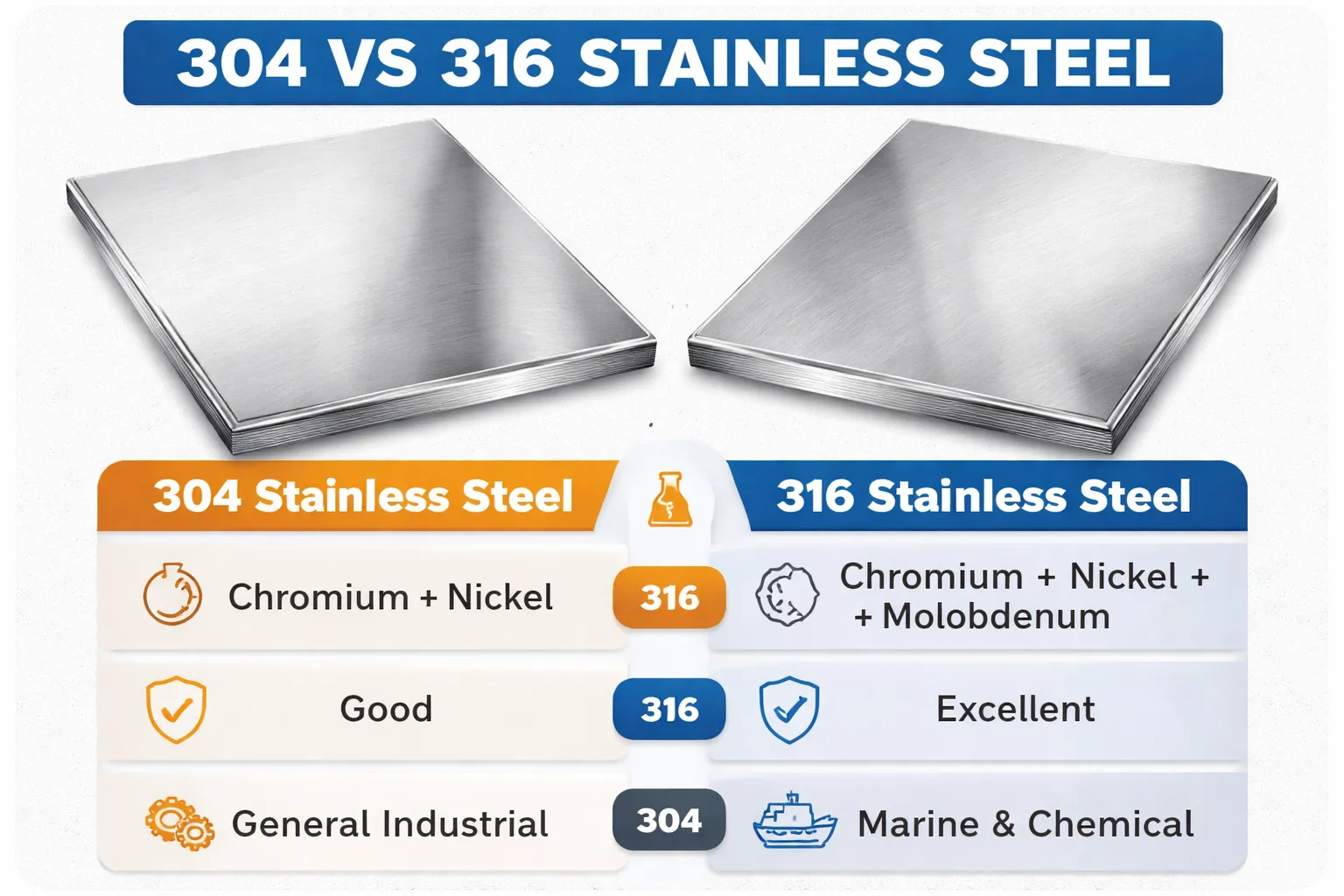
304 and 316 Stainless Steel
Below is how we’ll walk through this topic—step by step, from simple field tests to industrial-grade identification methods.
Stainless steel is generally an iron-based alloy with chromium that forms a passive protective layer. This is why stainless steel is resistant to corrosion compared with ordinary steel.
In global trade and fabrication, steel grades matter because each grade of stainless behaves differently in strength, weldability, and corrosion resistance. From my experience as a China-based stainless steel manufacturer and exporter, confusion between 304 and 316 is one of the most common problems buyers face.
For industrial distributors, OEM/ODM manufacturers, and engineering contractors, choosing the wrong grade can mean:
Premature rusting
Failed compliance checks
Customer claims or project delays
That’s why stainless steel identification is not optional—it’s essential.
The difference between 304 and 316 comes down to chemical composition.
| ציון | יסודות מרכזיים בסגסוגת | שימוש אופייני |
| נירוסטה 304 | Chromium + Nickel | General industrial, food equipment |
| נירוסטה 316 | Chromium + Nickel + מוליבדן | Marine, chemical, medical |
The presence of molybdenum (typically 2–3%) is what separates 316 stainless from 304 stainless. This element dramatically improves corrosion resistance, especially against chloride attack.
In short:
304 vs 316 → molybdenum is the deciding factor
316 stainless steel performs better in harsh environments
304 may corrode faster near salt, chemicals, or coastal air
This is one of the most common questions I hear.
Both 304 and 316 stainless steel belong to austenitic stainless steels. Austenitic stainless is generally non-magnetic in the annealed state.
The Magnet Test (Quick but Limited)
A magnet test checks for magnetic pull
304 and 316 stainless are non-magnetic in the annealed state
After cold working, slight magnetism can appear
So:
If steel strongly attracts a magnet, it may be lower-grade stainless, ferritic, martensitic, or even ordinary steel
Weak magnetism does not reliably tell 304 from 316
The magnet test is useful only as a screening tool, not a final answer.
Yes—spot test kits are widely used in workshops and warehouses.
A typical test kit uses chemical drops to detect molybdenum.
How a Spot Test Works
Clean the metal surface
Apply a test drop
Observe color change or reaction
No reaction → likely 304 stainless
Reaction present → indicates 316 stainless steel
This chemical test is fast, affordable, and popular among fabricators and B2B buying offices.
⚠️ Safety note: Some tests involve nitric acid, hydrochloric acid, or concentrated nitric acid—always use gloves and ventilation due to fume risk.
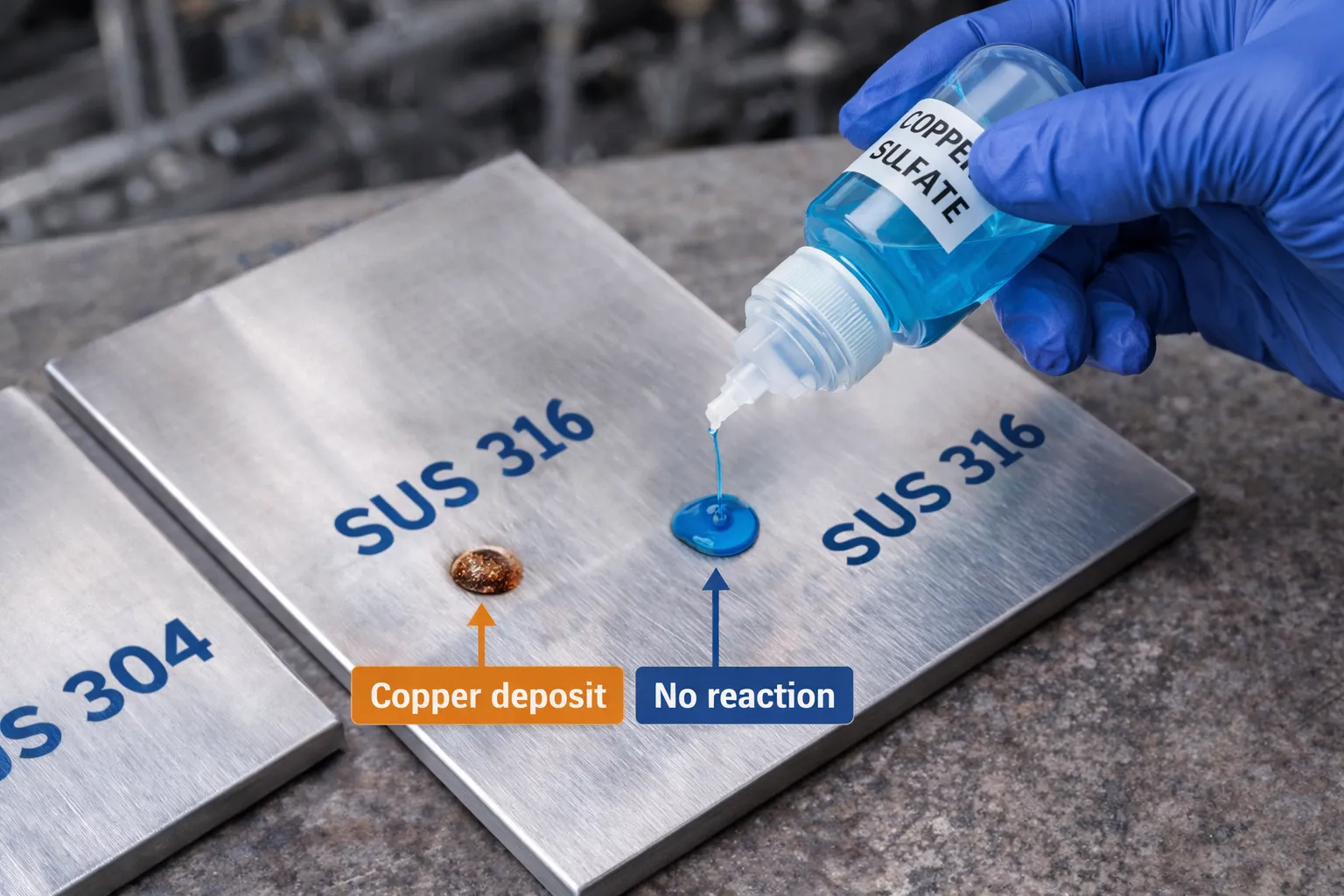
Can a Stainless Steel Test Kit Identify 304 or 316?
Copper sulfate testing is an old but still useful method in stainless steel detection.
304 stainless steel resists copper plating
Lower-grade stainless or ordinary steel shows copper deposition
However, copper sulfate cannot reliably distinguish 304 from 316. It only helps rule out different stainless or carbon steel.
Think of it as a basic filter, not a precise identifier.
For accuracy, yes.
The most reliable way to identify stainless steel is by analyzing elemental composition.
Key elements to check:
Chromium
ניקל
מוליבדן
Manganese content
If the analysis shows presence of Mo, the material is either 304 or 316? No—presence of molybdenum means 316, not ss 304.
This is why industrial buyers increasingly rely on PMI (Positive Material Identification).
XRF (X-ray fluorescence) is a nondestructive method widely used in export factories like ours.
Why XRF is trusted:
Fast (seconds per test)
Portable
Accurate for steel grades
Detects nickel, chromium, molybdenum
With x-ray fluorescence, we can tell 304 from 316 instantly—without damaging the product.
This method is ideal for:
Bulk shipments
Incoming inspection
OEM quality control
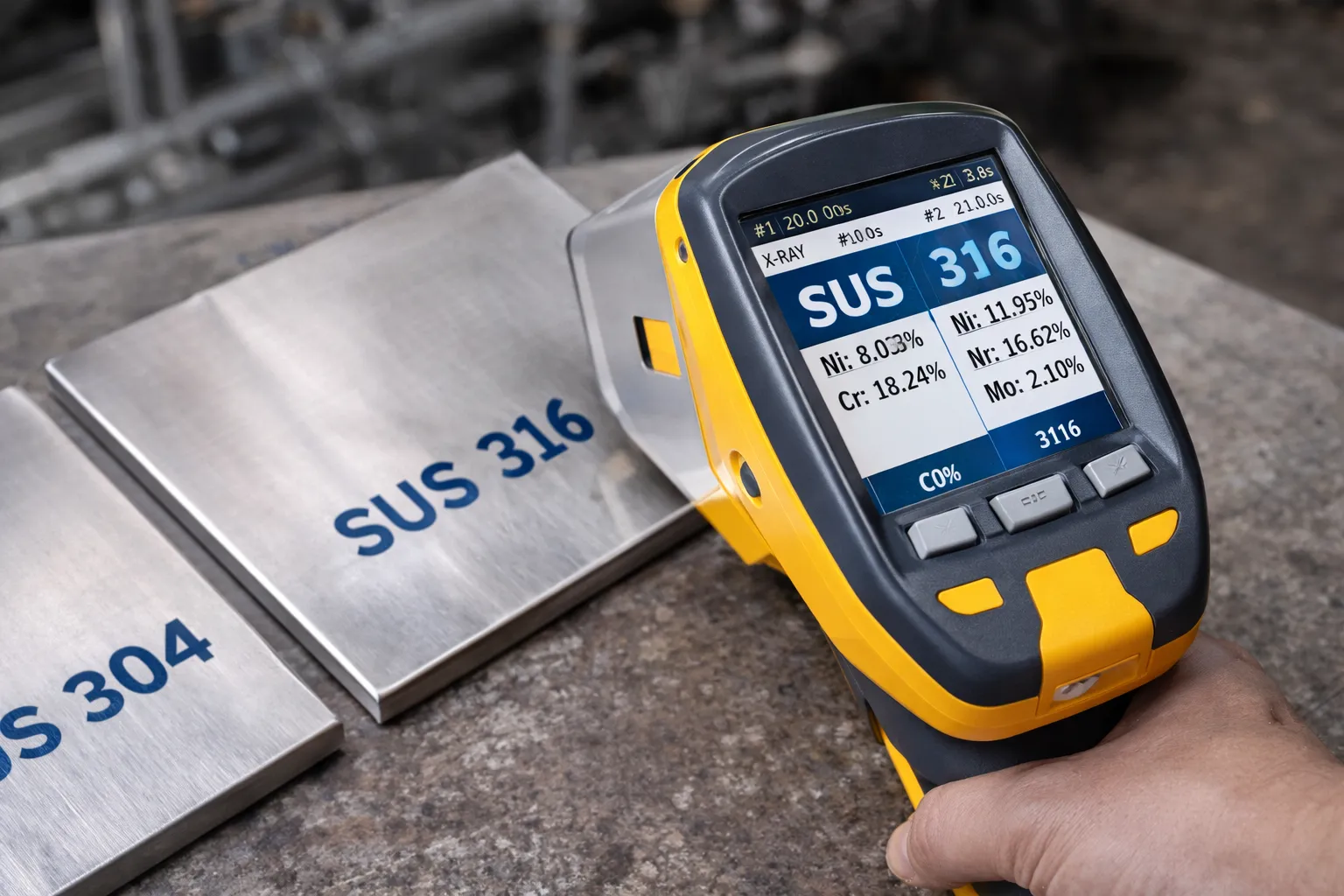
304 from 316 instantly
For even higher precision, labs use:
OES (Optical Emission Spectroscopy)
Stationary spectrometer
Advanced analyzer
These methods detect elemental percentages with extreme accuracy and are used when:
Projects require certification
Engineering standards are strict
Disputes arise over grade of stainless
304 and 316 stainless steel are austenitic.
In the annealed state → non-magnetic
After cold working → magnetism may appear
This is why steel are magnetic sometimes even when they’re stainless.
Understanding anneal, hot working, and cold-worked conditions helps avoid misjudgment during inspection.
Here’s a practical guide I often share with buyers:
| Situation | Recommended Method |
| Quick field check | Magnet + visual |
| Workshop verification | Spot test |
| Bulk purchasing | XRF |
| Certification required | OES |
| Dispute resolution | Lab analysis |
As a professional stainless steel manufacturer, we routinely combine simple tests with positive material identification to protect our clients.
How can I tell the difference between 304 and 316 without lab equipment?
Use a spot test to detect molybdenum. It’s the simplest way to tell the difference between 304 and 316 on-site.
Is 316L different from 316 stainless steel?
Yes. 316L has lower carbon content, improving weldability and reducing discoloration after welding.
Can spark test identify stainless steel?
A spark test can distinguish stainless from carbon steel, but it cannot reliably identify 304 or 316.
Why does my 304 stainless attract a magnet?
Because of cold working or ferrite formation. Austenitic stainless can show magnetism after processing.
Which grade is better for marine environments?
316 stainless steel. Its chloride resistance makes it ideal for coastal and chemical use.
Sources & Industry References
ASM International – Stainless Steel Handbook
Outokumpu Stainless Steel Technical Data
ISO 3506 & ASTM A240 standards
(Insights also based on first-hand export and factory QA experience.)
304 and 316 stainless steel look similar but behave differently
Molybdenum is the critical difference
Magnet test is limited—use with caution
Spot tests are practical and affordable
XRF and OES offer reliable, professional-grade identification
Proper stainless steel identification protects cost, safety, and reputation
If you’re sourcing stainless steel in bulk or need factory-direct verification, choosing the right identification method makes all the difference.
Stainless Steel Stair and Handrail Systems Supplied for an Indoor and Outdoor Precinct Project in Australia
Stainless Steel Staircases and Handrail Systems Delivered for an Indoor and Outdoor Precinct Project in Australia
Which Type of Stainless Steel Is Good for Railings? Choosing the Best Stainless Steel Railing System for Long-Term Performance
How to Identify Stainless Steel and Mild Steel: Key Differences Between Stainless Steel and Mild Steel
ווטסאפ