Choosing the wrong steel can lead to early corrosion, failed fabrication, and higher replacement costs. That gets expensive fast. The solution is to learn how to spot the real differences between stainless steels and mild steel before you buy, cut, or fabricate.
Sie können rostfreien Stahl und unlegierten Stahl oft anhand der Oberflächenbeschaffenheit, des Rostverhaltens, der Magnetreaktion, des Gewichts, der Ergebnisse von Funkentests und der Materialzertifikate unterscheiden. Einfach ausgedrückt enthält nichtrostender Stahl mindestens 10,5% Chrom, das eine schützende Chromoxidschicht für die Korrosionsbeständigkeit bildet, während Baustahl ein kohlenstoffarmer Stahl ist, der bei Feuchtigkeit leichter rostet.

What is steel, and why do buyers confuse these materials?
What is mild steel, and why is it so widely used?
What are stainless steels, and what makes them different?
What is the real difference between mild steel and stainless steel?
How can you identify stainless steel by appearance and surface condition?
Does using a magnet always work?
What can a spark test tell you?
How do stainless steel grades like 304 and 316 compare?
Which material is better for welding, machining, and fabrication?
Should you choose mild steel or stainless steel for your project?
At the most basic level, steel is an iron-and-carbon alloy. Britannica defines steel as an alloy of iron and carbon, with carbon content up to about 2 percent. That broad definition is exactly why people get confused: many materials are called steel, but they do not behave the same way.
In daily sourcing work, I often see buyers mix up mild steel and rostfreie Stähle because both can look silvery when new, both can be cut and fabricated, and both are used in construction, equipment, and industrial parts. But the chemistry is very different. One type of steel is designed mainly for cost-effective strength and fabrication. The other is designed for better corrosion resistance and cleaner long-term performance.
As a professional stainless steel manufacturer and exporter based in China, I always tell buyers one simple thing first: do not judge by color alone. The best way to differentiate these materials is to combine visual checks, basic shop tests, and verified mill documentation.
Mild steel is a low-carbon carbon steel. It is also known as low carbon steel, and many references place its carbon content roughly in the 0.05% to 0.3% range. Because of that low carbon level, mild steel is easier to form, easier to weld, and more economical than many higher-alloy materials.
You will often hear that mild steel is a plain carbon steel or is known as low carbon steel. That is basically correct in everyday industrial language. This low carbon content helps make it more ductile, more malleable, and more machinable than high carbon steel. It also means mild steel is widely used in frames, brackets, supports, structural sections, tanks, and general fabrication.
The downside is simple: mild steel does not have the same built-in protection as stainless steels. When exposed to moisture in the air, it can corrode and form iron oxide, which we commonly call rust. That is why painted or coated mild steel needs surface protection in many environments.
Quick facts about mild steel
| Eigentum | Baustahl |
|---|---|
| Main family | Kohlenstoffstahl |
| Carbon content | Niedrig |
| Kosten | Usually lower |
| Corrosion behavior | Dose Rost easily |
| Fabrikation | Very weldable and easy to form |
| Gemeinsame Nutzung | Structures, frames, general fabrication |
Stainless steels are steels that contain at least 10.5% chromium by mass. World Stainless explains that chromium is the key element that makes stainless steels “stainless,” and the Nickel Institute notes that once chromium exceeds that threshold, a protective oxide film forms on the surface.
This matters because stainless steel contains enough chromium to form a thin protective layer of chromium oxide on the surface of the metal. When the surface reacts with oxygen, that invisible film helps stop deeper attack. In practical terms, this means stainless steels are more resistant to corrosion than ordinary plain steel or mild steel.
Not all stainless steels are the same, though. Some are austenitic, some ferritic, some duplex, and each family has a different chemical composition. Common alloying element additions include chromium and nickel, and sometimes molybdenum for better corrosion performance in more aggressive environments. That is why buyers should pay attention not only to the word “stainless,” but also to the actual grade of stainless steel.
The main difference between mild steel and stainless steel is chemistry and performance. Mild steel is a low-carbon carbon steel. Stainless steel is a form of steel alloyed with enough chromium to become more corrosion-resistant. In many grades, nickel and sometimes molybdenum are also added to improve structure and performance.
In everyday use, the most important point is corrosion. Compared to mild steel, stainless steel handles wet, outdoor, food-contact, or chemical-exposed environments much better. Mild steel is much more likely to stain and rust without paint, galvanizing, or another coating. Stainless, by contrast, is built to resist surface breakdown through that chromium oxide film.
There are also fabrication differences. Mild steel is often easier to machine and can be very forgiving in basic fabrication. Some stainless steels are tougher, can work-harden faster, and may require more careful tooling. Still, the tradeoff is worth it when long-term cleanliness, durability, and appearance matter.
Mild steel vs stainless steel at a glance
| Eigentum | Baustahl | Rostfreier Stahl |
|---|---|---|
| Base type | Low-carbon Kohlenstoffstahl | Chromium-containing steel Legierung |
| Chromium content | Sehr niedrig | At least 10.5% |
| Rust behavior | Rusts easily | More korrosionsbeständig |
| Kosten | Unter | Höher |
| Surface look | Often duller over time | Cleaner, brighter finish |
| Gemeinsame Noten | Low-carbon structural steels | 304, 316, ferritic, duplex |
This is why the phrase stainless steel and mild steel should never be treated as if they are interchangeable.
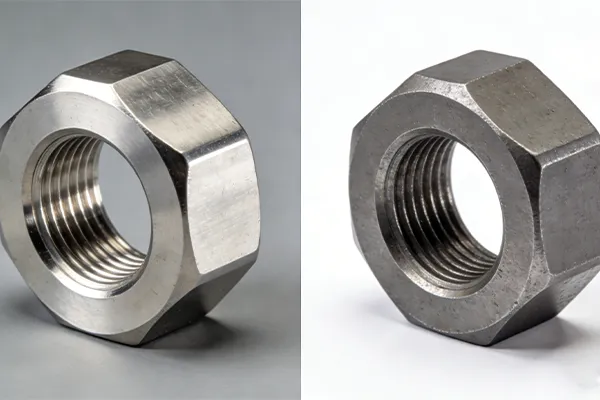
If you need to identify stainless steel quickly in a workshop or warehouse, start with the surface. Many stainless steels have a cleaner, brighter, and more uniform finish than mild steel. Even when both look silver at first, mild steel tends to darken, stain, or show early red-brown oxidation more easily.
A practical visual check is simple: look for pitting, surface staining, scale, or red rust. Mild steel exposed to damp air often forms visible iron oxide. Stainless usually stays cleaner because stainless steel has chromium, and that passive film protects it. This is not a perfect test, but it can help identify the likely material fast.
I usually tell B2B buyers to combine three basic steps:
Check the surface finish
Look for any active rust or staining
Ask for the mill test certificate
That last point matters most. For industrial distributors, contractors, and OEM buyers, appearance is helpful, but documents confirm the grade.
No. Using a magnet can be useful, but it is not a final answer. Many buyers assume all stainless is non-magnetic, but that is only partly true. Some austenitic grades are usually less magnetic in annealed condition, while ferritic and some other stainless grades can be magnetic. Cold working can also change magnetic response.
This means a magnet can help, but it cannot fully differentiate all different Edelstahlsorten from mild steel. In most cases, mild steel strongly attracts a magnet. Some stainless may attract weakly, some strongly, and some appear almost non-magnetic. So treat the magnet as a clue, not a certificate.
Here is the practical rule I share with buyers:
| Magnet result | Likely meaning |
|---|---|
| Strong attraction | Could be Baustahl or magnetic stainless |
| Weak attraction | Could be cold-worked austenitic stainless |
| Little or no attraction | Could be austenitischer Edelstahl wie 304 |
A magnet is fast. But if the material matters for a project, always confirm with paperwork or chemical testing.
A spark test is one of the oldest workshop checks for steel type. When material touches a grinding wheel or bench grinder, the spark stream gives clues about carbon and alloy content. This is a useful field method when you do not have full lab equipment.
In simple terms, mild steel usually throws longer, brighter, more branching spark patterns than many stainless steels. Stainless often produces shorter, darker, less explosive sparks. That happens because alloy chemistry changes how the material behaves under grinding. So a spark test can be helpful when comparing unknown samples side by side.
Still, I want to be honest here: the spark test takes experience. Lighting, wheel condition, and operator skill all affect the result. It is good for quick shop sorting, but not for final grade confirmation. For export orders, stock control, and project-critical material, lab chemistry and certificates are still the safer answer.
When buyers ask about stainless steel grades, the most common questions are about 304 and 316. These are among the best-known grades of stainless in the global market. 304 is widely used because it balances cost, corrosion resistance, and formability well. 316 adds molybdenum, which improves performance in chloride or more aggressive environments.
If you are comparing like 304 and 316, think about environment first. For indoor equipment, general fabrication, kitchen products, or many architectural uses, 304 is often enough. For marine exposure, chemicals, or higher-corrosion service, 316 may be the better choice. This is why knowing the grades of stainless matters more than just asking for “stainless.”
There are also other types of stainless, including ferritic and duplex materials. So when people talk about the differences between stainless steel, they are really talking about a whole family of materials, not one single metal. World Stainless notes that stainless is an umbrella term for a broad family, and that is exactly right.
Common stainless grade guide
| Klasse | Key alloy points | Typische Verwendung |
|---|---|---|
| 304 | Chromium + nickel | General industrial and architectural use |
| 316 | Chromium + nickel + Molybdän | Marine, chemical, higher-corrosion areas |
| Ferritic grades | Iron + chromium, lower nickel | Cost-sensitive corrosion-resistant uses |
This depends on the job. Mild steel is usually easier to process in basic fabrication. It is highly weldable, easier to drill and machine, and often more forgiving for general structural work. That is one reason it remains common in workshops worldwide.
Stainless can also be weldable, but the exact behavior depends on grade. Some stainless steels are tougher and can work-harden more quickly. That can affect tool life and machining speed. In some cases, stainless steel is generally stronger against corrosion but a little more demanding in fabrication than low-carbon structural steel.
Als China-based exporter, I usually explain it this way to buyers:
Choose mild steel when cost and easy fabrication matter most
Choose stainless when service life, appearance, hygiene, or corrosion exposure matters more
Match the grade to the environment, not just the budget
This is especially important for contractors, OEM product manufacturers, and trading companies placing bulk orders.
If your project is dry, painted, indoor, and cost-sensitive, mild steel or stainless steel should not be seen as equal-cost options. Mild steel is often the economical answer. It is strong, ductile, and widely available. That makes it a smart material for frames, supports, and non-corrosive service.
But if your application faces water, chemicals, food contact, outdoor weather, or strict hygiene demands, stainless is often the better long-term choice. Even if initial cost is higher, the lower risk of staining, maintenance, and premature failure can make it the smarter total-cost decision.
For buyers, I recommend this simple checklist:
Choosing mild steel and stainless steel
Does the part face water or chemicals?
Does appearance matter over time?
Is hygiene or easy cleaning important?
Does the job need higher corrosion resistance?
Is budget the main driver?
Do you need a specific grade such as 304 or 316?
The best answer is not always the cheapest one. It is the material that fits the application.

In international business, material confusion causes real problems. We have seen buyers receive the wrong steel pipe, the wrong sheet grade, or mixed warehouse stock because the order relied on visual inspection only. That is risky.
For industrial distributors, steel wholesalers, contractors, and import offices, I strongly suggest these steps before shipment:
Confirm the exact grade of stainless steel or carbon steel standard
Review mill test certificates
Check surface finish requirements
Ask whether the material is annealed, pickled, polished, or coated
Request PMI or third-party inspection if the job is critical
Separate stainless and mild steel stock clearly in the warehouse
That process reduces claims, delays, and costly on-site surprises. In bulk export supply, clarity is everything.
Is mild steel the same as carbon steel?
Not exactly. Mild steel is a type of carbon steel, usually with relatively low carbon content. But not all carbon steel is mild steel, because some carbon steels have medium or high carbon levels.
Can stainless steel rust?
Yes, in some conditions it can stain or corrode, especially if the grade is wrong for the environment or the surface is contaminated. But in general, stainless steels are far more resistant to rust than mild steel because of their chromium-rich passive film.
Is 304 stainless magnetic?
Often it is only weakly magnetic or appears mostly non-magnetic in annealed condition, but cold working can increase magnetic response. So magnet testing alone is not enough for final identification.
What is the easiest way to tell mild steel from stainless steel?
The easiest first check is to compare rust behavior, surface finish, and magnet response. The most reliable final method is to verify the certificate or test the chemistry.
Which is cheaper, mild steel or stainless steel?
In most cases, mild steel is cheaper than stainless steel. Stainless costs more because of alloy content such as chromium and often nickel or molybdenum.
Is 316 better than 304?
Not in every case. 316 is usually better for chloride or more corrosive environments because it contains molybdenum. 304 is often enough for many general applications.
Steel is a broad family, so buyers should not assume all steels behave the same.
Mild steel is a low-carbon carbon steel that is economical, easy to fabricate, and prone to rust.
Stainless steels contain at least 10.5% chromium, which helps form a chromium oxide passive film.
The biggest practical difference between mild steel and stainless steel is corrosion resistance.
A magnet and spark test can help, but they do not replace certificates or chemical analysis.
304 and 316 are common stainless steel grades, with 316 usually better in harsher corrosive environments.
For bulk B2B purchasing, always confirm grade, finish, and inspection documents before shipment.
The best material choice depends on environment, fabrication needs, appearance, and total life-cycle cost.